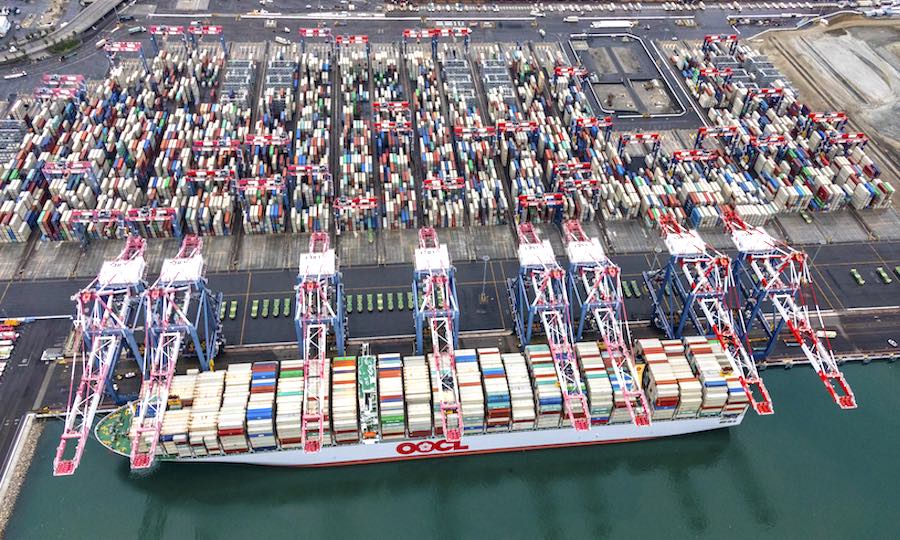
Container carriers are earning substantially more spot revenue per nautical mile on transpacific services than on routes from Asia to Europe, according to Alphaliner analysis reported by Splash247. The strength of the US trade has extended beyond the usual peak season, with freight rates nearing pandemic-era levels even as some assessments begin to soften.
Alphaliner put the Shanghai–Los Angeles spot rate at approximately $7,500 per forty-foot equivalent unit (feu). Across the 5,775-nautical-mile voyage, that equates to $1.30 per container per nautical mile, five times the 26 cents earned on Shanghai–Rotterdam sailings around the Cape of Good Hope. The equivalent figure via Suez was 34 cents. Shanghai–New York generated 96 cents per nautical mile, with spot rates above $10,000 per feu since late August. These comparisons measure revenue, not profitability.
Operators are increasing Pacific deployment in response. Splash247 reported that MSC had replaced ships of about 15,000 teu on its Sentosa service with 23,600 teu megamaxes. ZIM, which already allocates 52% of its capacity to the Pacific, plans to introduce another China–California service in December. COSCO’s third-quarter liner profit reached $2.66bn, twice the year-earlier figure, while its transpacific revenue increased by 61.2%.
Freightos assessments cited by Splash247 showed continued strength into November, with Asia–US west coast rates at $8,340 per feu and east coast rates at $9,911. Freightos said rates were still approximately $5,500 per feu above levels before the peak season. It also suggested that demand ahead of Lunar New Year could restrict the scale of any downward adjustment.
Other indicators suggest the market is losing momentum. Drewry recorded a 6% weekly fall in Shanghai–Los Angeles rates to $7,514 and a 5% decline on Shanghai–New York to $9,631. The consultancy anticipated further declines, with US seaborne imports forecast to fall 11% month on month in November. Meanwhile, Sea-Intelligence warned of unprecedented transpacific capacity deployment, with weekly Asia–US west coast capacity expected to reach 400,000 teu in November, although congestion and delayed sailings were inflating that measure.