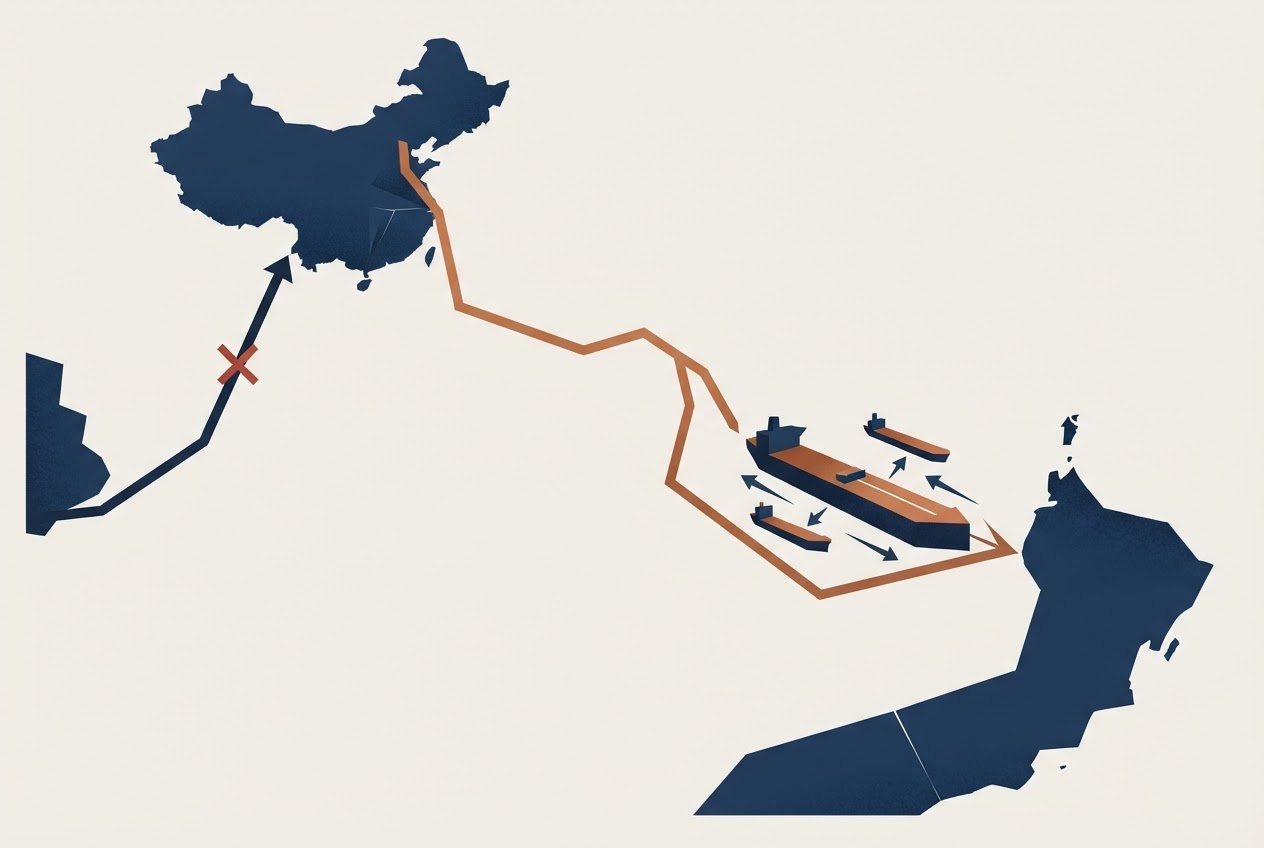
China’s crude stock draws and a growing tanker transfer network outside the Strait of Hormuz are reshaping VLCC demand, according to Signal Group analysis published by Hellenic Shipping News. Loading in the Gulf of Oman remained cheaper for Chinese buyers than sourcing from West Africa, despite sharply higher earnings on routes from inside the Strait.
Chinese customs crude imports reached 9.03 million barrels per day in September, little changed from August, while refinery throughput increased to 13.99 million bpd. The analysis calculated a net stock draw of 0.60 million bpd after crude exports. Of the 121.5 million barrels accumulated by April, 31 million remained; maintaining the May-September drawdown rate would exhaust that addition by late November, rather than deplete China’s entire stockpile.
The report described two successive diversions of Gulf supply following Hormuz’s closure. Saudi pipeline shipments to Red Sea terminals initially provided the main alternative, reaching about 4.3 million bpd in June. After an August attack on the East-West pipeline, more crude crossed the Strait aboard tankers before being transferred to VLCCs off Fujairah, Khor Fakkan and Sohar. This relay handled about 5 million bpd in September, up from almost nothing in February.
Voyage duration helps explain why lower Atlantic daily earnings did not necessarily deliver the cheapest cargoes. For a VLCC carrying approximately 2 million barrels to Ningbo in September, the analysis put freight at about $26 per barrel from Ras Tanura, $17.50 from West Africa and $15 from Oman’s Mina al Fahal. In October, the respective costs rose to about $34, $28 and $19. The longer West African round voyage partly offset its lower daily rate.
The transfer system also increased vessel requirements: each relayed cargo employed two tankers and incurred waiting time. Freight on the Gulf of Oman-China TD34 route tripled month on month in September, according to the report. Atlantic supply subsequently tightened, with VLCCs ballasting towards West Africa, Brazil and the US Gulf falling from roughly 85 a week in early September to 50-54 since mid-October. West Africa-China TD15 rates climbed 60% month on month in Worldscale terms, lifting earnings to $667,000 a day.
China nevertheless continued Atlantic purchases, with 19 VLCCs fixed from Brazil and West Africa during October’s final ten days, mostly for November loading. Signal Group said an effective Oman transfer network could sustain Gulf-led replenishment and draw more tonnage east. Disruption would instead leave China choosing between deeper stock draws and longer-haul purchases carrying higher freight costs.